Adding Capacity? Think Again.

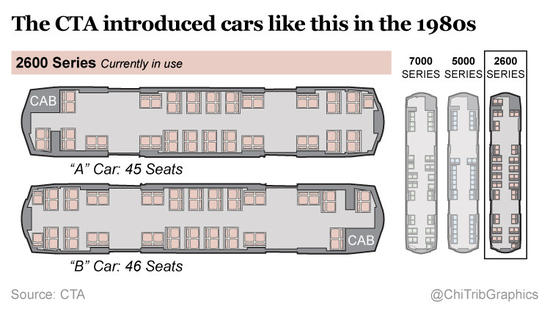
One look at the redesigned El cars, and you knew how wrong they were.
But the CTA didn’t see any problem and ordered a bunch.

One look at the proposed Belmont Flyover, and it’s clear what a bad plan it is. Here’s hoping they think twice this time.

CTA Rounding the Curve Slowly on Next Rail Car Purchase
Jon Hilkevitch, Chicago Tribune, 4/26/2015

“The strategy was to cram more riders onto each rail car, reduce the amount of time that trains are stopped at stations and operate more peak-hour train runs through the LoopL” structure.”
SOUND FAMILIAR?

“None of those goals has been achieved, according to the CTA study.”

chi-cta-train-seating-getting-around-met-20150-005

excerpt from the article:
As the CTA moves cautiously toward a decision on its next-generation rail cars, a study published in a national research journal presents a painstakingly detailed account of how the transit agency went off the tracks when it selected the aisle-facing seat design on the 5000 Series.

The study titled “Is This Seat Taken?” was conducted by two CTA planning and market research employees. They questioned CTA estimates and assumptions that longitudinal aisle-facing seating would increase passenger capacity on each car.

As many riders will attest, a common scene on the new 5000 Series rail cars is that hardly anybody uses the seat between two seated passengers on the aisle-facing seats, because riders would be uncomfortably squeezed shoulder to shoulder and thigh to thigh. Another complaint is that the sight line outside the window on the opposite side of the car is often blocked by standing passengers, whose midsections are eye-level to seated passengers.

The 5000 Series cars have been phased in since 2011, under decisions set in motion by Frank Kruesi, who was CTA president for 91/2 years during the administration of Mayor Richard M. Daley. The aisle-facing longitudinal scoop seats, which represent about 90 percent of the 38 seats in each 5000 Series car, broke the modern-day CTA tradition of having mostly forward- and- rear-facing seats. The strategy was to cram more riders onto each rail car, reduce the amount of time that trains are stopped at stations and operate more peak-hour train runs through the LoopL” structure.

None of those goals has been achieved, according to the CTA study by Tara O’Malley, CTA coordinator of market research, and Maulik Vaishnav, a CTA resource planner. Their study was published earlier this year by the Washington-based Transportation Research Board, which promotes innovation in transportation through research and also provides advice on transportation policy.

During a series of counts made on CTA trains, the maximum passenger loading observed averaged 101 passengers on a 5000 Series rail car, lower than a projection of 106 to 134 passengers per car, the study found.

Meanwhile, the maximum passenger loading observed fell on the high end of expectations on two earlier models of CTA rail cars, the 2400/2600 Series and the roughly 20-year-old 3200 Series, the latter of which is being overhauled and is scheduled to remain in service on the Brown and Orange lines until at least the early 2020s.

That O’Hare Escalator Situation

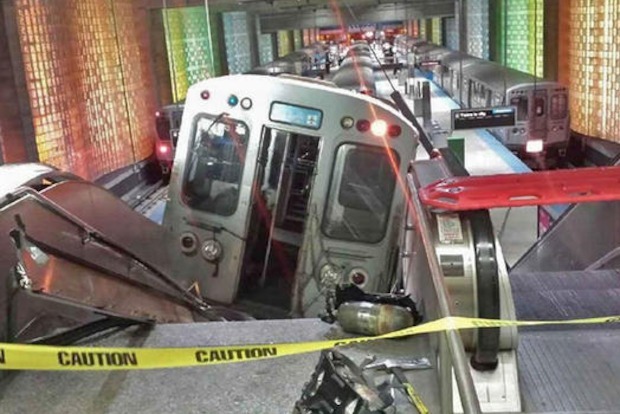
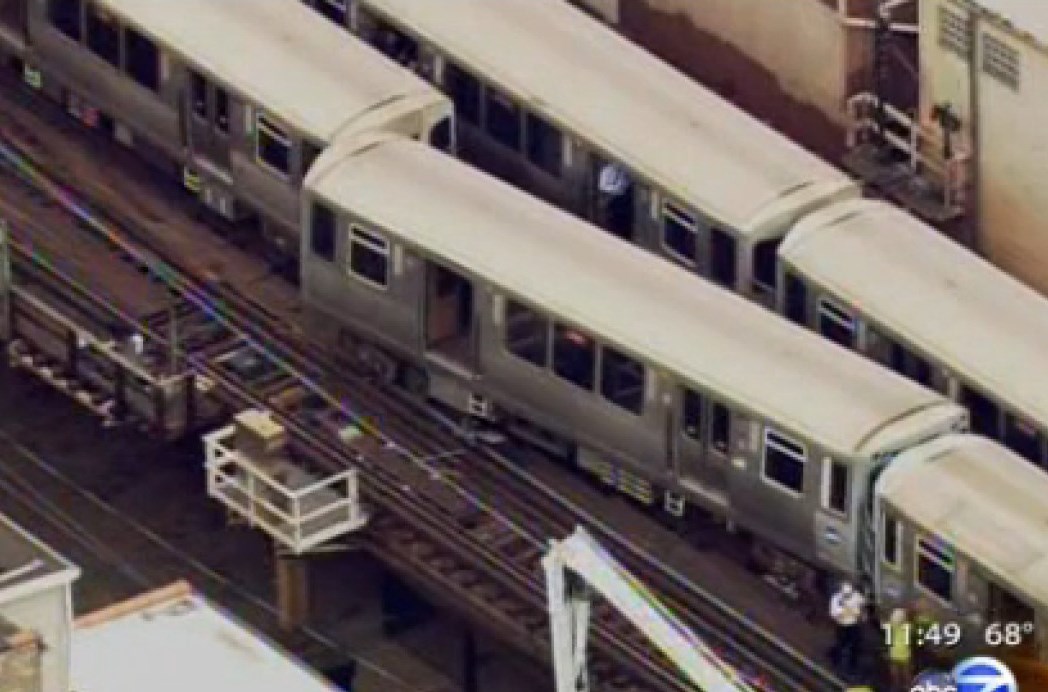
Remember the CTA train that rode up the escalator at O’Hare?  It’s been a year and the escalator still hasn’t been replaced. Construction will start “sometime in the coming months,” according to CTA spokesperson Brian Steele.

The crash occurred because the operator dozed off. And she had done it before. No room for mistakes at O’Hare – or on the proposed Belmont Flyover.

OHare escalator

CTA Replacing O’Hare Escalator That Train Rode Up Exactly One Year Ago
By Tanveer Ali, DNAinfo, 3/24/15

One year ago Tuesday, a Blue Line train failed to stop in time at the O’Hare CTA station.

The operator, who admitted to being tired before the crash, was fired by the CTA. She was involved in a similar incident the month before, when she dozed off and failed to stop a train in time at a station.

No one was killed in the early morning O’Hare crash, though 35 people were sent to the hospital. Several lawsuits were filed.

“It was a scary thing to see,” Robert Kelly, president of Amalgamated Transit Union Local 308, said following the crash. “If this would’ve happened three hours later I have no doubt there would’ve been multiple fatalities.”

The crash also caused $9.1 million in damages, including to one of two escalators that was replaced with stairs.

While the other escalator switched directions to take people up to the terminals, there will be soon a second escalator that will allow weary travelers to avoid walking on stairs, said agency spokesman Brian Steele.

“This escalator is being custom fabricated for the O’Hare station, and is a complex project in a comparatively tight space,” Steele said.

Construction is expected to begin sometime in the coming months. The station will be back to pre-crash form by the end of the year, Steele said.

Chuy Says NO to the Flyover!

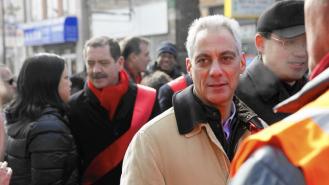
chuy+ rahm

By Tracy Swartz, RedEye, March 2, 2015

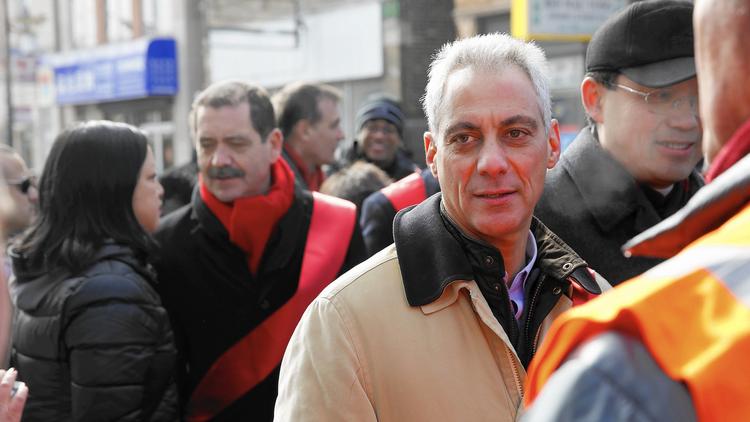
Add one more item to the list of topics Mayor Emanuel and his formidable challenger Cook County Commissioner Jesus “Chuy” Garcia disagree on: Emanuel’s proposed flyover at the Belmont stop in Lakeview.

Though they’ve spent lots of time shaking commuter hands at CTA stops, Emanuel and Garcia have been vague on what Chicago transit will look like over the next four years. Garcia hasn’t detailed what specific transit projects he would push if he were elected while Emanuel has stuck to promoting plans already announced or in the works.

One Emanuel proposal Garcia is against is the proposed $320 million flyover, which Garcia criticized as “an unnecessary expenditure of taxpayer funds that will generate little return on investment” in an email via his spokeswoman.

Under Emanuel’s direction, the CTA has proposed creating an elevated ramp that would allow Brown Line trains to bypass Red and Purple Line train traffic at the Belmont stop.

The move would reduce commute wait times at that station by a few minutes and is necessary to be able to handle future Red Line train capacity, CTA officials say. But some Lakeview residents have complained that the ramp would look like a rollercoaster in the middle of their neighborhood and more than a dozen buildings would be torn down to build the flyover.

There is no specific construction timeline for the proposed Belmont flyover, which is awaiting funding.

Emanuel has not recently laid out new plans for the CTA but has pushed proposals already in the works, including the continuation of repair work to North Side Blue Line stations. If funding is found, the city also likely will move forward on a controversial proposal to create a $160 million express bus system along Ashland Avenue.

For his part, Garcia hasn’t been specific about his Chicago transit plans. On his website chicagoforchuy.com, Garcia advocates finding new ways to fund public transit, including private partnerships, but doesn’t mention any specific projects he would pursue if he is elected mayor.

The mayor plays a large role in the future of the CTA because the mayor picks the CTA president and half the members of the CTA board. The CTA’s list of projects is the mayor’s list of projects. From the proposed Ashland Avenue express bus system to increasing CTA ridership, RedEye compares Emanuel’s transit priorities with Garcia’s priorities.

On his top transit priority: Emanuel’s priority is to “continue rebuilding the Red Line— both the north branch and extending it past 95th,” spokesman David Spielfogel said in an email. The CTA plans on holding community meetings this year about potentially extending the Red Line from 95th Street to 130th Street, a project that has been talked about for decades.

In an email through his spokeswoman, Garcia said his top transit priority “would be to provide sufficient and stable funding for transit in the region.”

On how to increase CTA ridership: Though the CTA still is calculating ridership figures from December, it looks like the agency will see its second consecutive year of ridership decreases systemwide.

Emanuel spokesman Adam Collins said CTA ridership “remains strong” but saw a dip last year because of sub-zero temperatures.

Garcia said to increase ridership, ideally all transit lines, not just the Red and Blue lines, should operate round the clock. The cost of increasing that service is unknown. “No parts of Chicago or the metropolitan area should be isolated from public transit; twenty-four hour service should be available to all communities; and, the different systems (CTA, Metra, Pace) should be integrated to attract more riders,” Garcia said in an email.

On the Ashland Avenue express bus system: Under Emanuel, the CTA has proposed building an express bus system, called bus rapid transit, along 16 miles of Ashland Avenue from Irving Park Road on the North Side to 95th Street on the South Side. The proposal would speed bus commutes on Ashland Avenue, but some local residents and business owners have expressed concern over the elimination of car lanes and left-hand turns on the busy thoroughfare.

Garcia said he would support the Ashland proposal if there is a better compromise with residents and business associations. “There are a multitude of concerns that have been raised, including limited number of car lanes and left turns,” Garcia said in an email.

On retaining Forrest Claypool as CTA president: Emanuel would retain Claypool as president because Claypool has consistently delivered projects on schedule and within budget and he’s focused on improving the ridership experience, Spielfogel said.

Garcia said he would make this decision upon election. Claypool, a former Cook County commissioner, endorsed Garcia in his campaign for a seat on the Cook County Board more than five years ago.

A $400Million Superstation To Nowhere

“It’s absolutely wacko,” says Greg Hinz, political writer at Crain’s.
“Somebody in power wanted it, so they did it.”

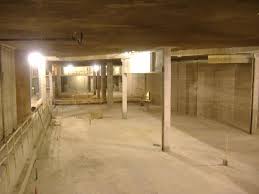
Remember the CTA’s Superstation idea?  Now, we have a vast, useless hole under Block 37 in the heart of downtown Chicago. $400Million and counting. Project scrapped.

Recently, they floated a plan to construct a second Blue Line track high above the existing track just to speed big-deal execs downtown 7 minutes faster than the regular folks down below. Now, they admit the current Blue Line already is 10 minutes faster thanks to ongoing track repair.

AND NOW, they want to spend $570Million+ on a roller coaster at Belmont to shave 20-30 seconds off the Northside Red Line commute. Want to pay for that, too?

superstation

How Chicago Spent $400 Million on a Subway Superstation to Nowhere
by Phil Rogers, NBC Chicago

Imagine a scenario where you bury a lot of your hard earned money in the yard, and never see it again. Better yet, imagine giving that money to someone else, who buries it with promises of big returns which never happen.

You’ve already done it.

The site is deep below Chicago’s famous Block 37 between State and Dearborn at Randolph. A decade ago, the Chicago Transit Authority wanted to launch non-stop train service from the Loop to O’Hare and Midway airports. But the closest the service came to reality was the shell of a mass transit “superstation” below Block 37 between the Red and Blue subway lines. The project was shelved, amid mounting costs and questions about funding and the very feasibility of the concept.

“It was definitely something that was ill conceived, ill planned, that was premature in beginning construction,” says the Civic Federation’s Lawrence Msall. “It’s hard to come up with a description of that kind of incompetence.”

“It’s absolutely wacko,” says Greg Hinz, political writer at Crain’s Chicago Business. “Somebody in power wanted it, so they did it.”

Can’t Hurt Thriving Lakeview?

The CTA insists that Central Lakeview’s thriving restaurant, shopping, entertainment district is so successful that erecting the Flyover 45′ in the air right over Clark St. can’t possibly hurt. Really?

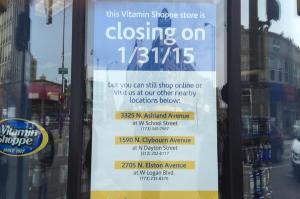
vitamin-shoppe closingRetailers and Restauranteurs Heading for the Exit in Lakeview
Lewis Lazare, Chicago Business Journal, 2/3/15

What it all means for Chicago and some of its struggling merchants may not be completely clear for several more years.

But as one Vitamin Shoppe employee was busy packing up the remaining merchandise in the store Saturday afternoon, he was certainly crystal clear about his take on the situation. “Welcome to the next Detroit,” he said as I exited the store for the last time.

Look & Learn: The Belmont-Western Flyover Nightmare

Maybe the CTA could look and learn?  The Western Avenue traffic flyover at Belmont put an end to development for the surrounding commercial/residential community.  50+ years later, they’re finally tearing it down.

Belmont-Western flyoverWestern & Belmont Viaduct to Vanish, 1.3 Miles of Wider Sidewalks Planned
Streetsblog Chicago, 6/10/14

The Chicago Department of Transportation plans to tear down the structurally deficient 52-year-old viaduct that lifts traffic on Western Avenue over the intersection of Belmont and Clybourn. Instead of a gloomy concrete interchange walling off the edge of Roscoe Village, a more conventional surface-level intersection could be built as soon as 2016.

RTA Report: $3 Billion Farther Behind for Maintenance, Repair

o-CTA-RED-LINE-DERAILMENT-facebookRTA Report: CTA, Metra, PACE Falling Behind in Funding for Equipment
Richard Wronski, Chicago Tribune, 1/22/15

Chicago’s three transit agencies have fallen $3 billion further behind previous years in investing in new equipment and maintaining existing trains, buses and infrastructure, a new report by the Regional Transportation Authority said Thursday.

“The current rate of annual reinvestment is insufficient to address the region’s normal (equipment) replacement needs, leading to … growth in the size of the investment backlog and an associated decline in overall asset conditions,” the report said.

The CTA accounts for 62 percent of the regional capital funding needs, while Metra’s share is 32.4 percent, and Pace’s is 6.3 percent, the report says.